

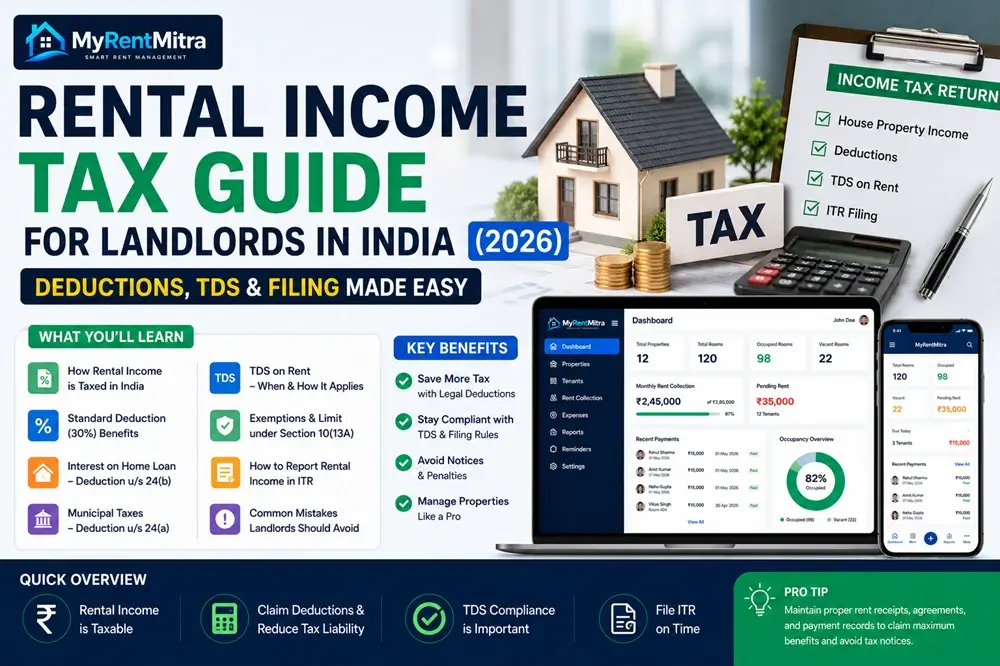
Quick Answer: Rental income earned by landlords in India is taxed under the head "Income from House Property" and is added to their total taxable income. Landlords can claim a flat 30% standard deduction on the annual rental value (after deducting municipal taxes), plus a deduction on home loan interest if applicable. Tenants paying rent above ₹50,000 per month must deduct TDS at 2% before paying the landlord. Understanding these rules correctly helps landlords avoid overpaying tax or facing notices for underreporting.
Owning a rental property comes with a tax obligation that many first-time landlords underestimate — or get wrong. Whether you rent out one room or manage multiple properties, this guide breaks down exactly how rental income is taxed in India, what deductions you're entitled to, when TDS applies, and how to file it correctly in 2026.
How Is Rental Income Taxed in India?
Rental income from any property — residential or commercial — falls under the head "Income from House Property" in the Income Tax Act. It is calculated as follows:
- Gross Annual Value (GAV) — the actual rent received or the reasonable expected rent, whichever is higher
- Less: Municipal taxes paid — property tax paid to the local municipal corporation during the year
- Net Annual Value (NAV) = GAV − Municipal taxes
- Less: Standard deduction of 30% on NAV — a flat deduction allowed regardless of actual expenses incurred
- Less: Home loan interest deduction (if the property is financed through a home loan)
- = Taxable Income from House Property
This resulting figure is added to the landlord's total income for the year and taxed according to their applicable income tax slab.
Example Calculation
Suppose a landlord receives ₹3,00,000 in annual rent and pays ₹15,000 in municipal taxes:
- Gross Annual Value: ₹3,00,000
- Less municipal taxes: ₹15,000
- Net Annual Value: ₹2,85,000
- Less 30% standard deduction: ₹85,500
- Taxable Income from House Property: ₹1,99,500
If the landlord also has an outstanding home loan on the property, interest paid during the year can be deducted separately, further reducing taxable income.
The 30% Standard Deduction — What Landlords Should Know
This is one of the most valuable and misunderstood deductions available to landlords. Key points:
- It is a flat 30% deduction on Net Annual Value, regardless of whether the landlord actually spent that amount on repairs or maintenance
- It applies even if the landlord spent nothing on upkeep that year
- It cannot be claimed in addition to actual repair expenses — you get the flat 30%, not both
- It is available for let-out properties, not for self-occupied ones (since self-occupied property typically has nil annual value)
Home Loan Interest Deduction for Rental Property
If a landlord has taken a home loan for the rented property, interest paid during the year is deductible under Section 24(b). Important details:
- For a let-out property, there is no upper limit on the interest deduction (unlike self-occupied property, which is capped at ₹2,00,000 per year)
- The deduction applies to interest paid, not principal repayment (principal repayment may qualify separately under Section 80C, subject to overall limits)
- If the total interest deduction results in a loss under "Income from House Property," landlords can set off up to ₹2,00,000 of this loss against other income in the same year, with the remaining loss carried forward for up to 8 assessment years
This makes owning a rented property with an active home loan considerably more tax-efficient than many landlords realize.
TDS on Rent — What Landlords and Tenants Must Know
Tax Deducted at Source (TDS) rules apply differently depending on who is paying the rent and how much:
For individual/HUF tenants:
- If monthly rent exceeds ₹50,000, the tenant must deduct TDS at 2% before paying the landlord, under Section 194-IB
- This TDS is deducted once a year (typically in the last month of the tenancy or financial year) rather than every month
- The tenant must deposit this TDS with the government and provide the landlord a TDS certificate (Form 16C)
For business/company tenants:
- If the tenant is a business entity, TDS under Section 194-I applies at 2% for plant/machinery or 10% for land/building/furniture, deducted monthly, regardless of the ₹50,000 threshold in many cases
For landlords:
- TDS deducted by the tenant can be claimed as credit while filing the landlord's income tax return, reducing the final tax payable
- Landlords should always request Form 16C or the relevant TDS certificate to ensure the credit reflects correctly in their Form 26AS
Does GST Apply to Rental Income?
GST on rental income depends on the type of property and use:
- Residential property rented for residential use is generally exempt from GST
- Residential property rented to a business entity (for commercial use, or rented to a GST-registered entity) may attract GST under reverse charge rules, depending on current provisions
- Commercial property (shops, offices, warehouses) rented out is typically subject to 18% GST, if the landlord's aggregate turnover exceeds the GST registration threshold
Because GST applicability on rental arrangements has seen periodic clarifications, landlords renting commercial property or renting to business tenants should verify current rules with a tax professional or the GST portal before assuming exemption.
Filing Rental Income in Your ITR
Landlords need to report rental income under the "Income from House Property" schedule while filing their Income Tax Return. Key steps:
- Choose the correct ITR form — salaried landlords with one or two house properties typically use ITR-1 or ITR-2, while those with more complex income (business income, multiple properties) may need ITR-3 or ITR-4
- Report Gross Annual Value accurately based on actual rent received
- Claim municipal tax deduction with supporting receipts
- Apply the 30% standard deduction automatically calculated on Net Annual Value
- Claim home loan interest deduction, if applicable, with supporting loan interest certificate from the lender
- Reconcile TDS credit shown in Form 26AS against rent received, to ensure the tenant's deducted TDS is correctly reflected
Common Mistakes Landlords Make With Rental Income Tax
- Not reporting rental income at all, assuming small amounts go unnoticed — tax authorities increasingly cross-check rent data through TDS filings and property records
- Forgetting to claim the 30% standard deduction, resulting in landlords overpaying tax unnecessarily
- Confusing rent received with taxable income, without applying municipal tax and standard deductions first
- Not tracking TDS certificates, leading to mismatches between what was deducted and what appears in Form 26AS
- Assuming all rental income is GST-exempt, without checking whether the tenant is a business entity or the property is used commercially
- Poor record-keeping across multiple tenants or properties, making it difficult to reconcile actual rent received versus what's reported
Self-Occupied vs. Let-Out Property: Why the Distinction Matters
Many landlords own more than one property, and how each is classified affects tax treatment significantly:
- Self-occupied property (SOP): If a landlord lives in one property and doesn't rent it out, its annual value is considered nil for tax purposes. Home loan interest on this property is deductible only up to ₹2,00,000 per year.
- Let-out property (LOP): Any property rented out is taxed as described above — full annual value, minus municipal taxes, minus 30% standard deduction, minus home loan interest with no upper cap.
- Deemed let-out property: If a landlord owns more than two properties and doesn't rent out the additional ones, tax rules may treat the extra properties as "deemed to be let out," meaning notional rental income gets added to taxable income even if no rent was actually received. This catches many landlords with multiple vacant properties off guard.
Landlords with multiple properties should carefully review which properties qualify as self-occupied versus deemed let-out each financial year, since incorrect classification is a common source of under- or over-reported tax.
Advance Tax Obligations for Landlords
If a landlord's total tax liability (including tax on rental income) exceeds ₹10,000 in a financial year, advance tax rules apply. This means tax needs to be paid in instalments during the year — typically by mid-June, mid-September, mid-December, and mid-March — rather than as a single payment at the time of filing the return.
Landlords who receive substantial rental income, especially from multiple properties or tenants, should account for this while planning payments, since missing advance tax deadlines can attract interest under Sections 234B and 234C. Keeping a running estimate of annual rental income — rather than only calculating it after the financial year ends — makes advance tax planning considerably easier.
Why Accurate Rent Records Matter for Tax Filing
Since taxable rental income starts with actual rent received, landlords need clean, accurate records of what was collected each month, from whom, and when — especially if they manage multiple tenants or properties. Missing or inconsistent records can lead to under-reporting (risking penalties) or over-reporting (paying more tax than necessary).
This is where using a dedicated rent management platform becomes useful beyond just day-to-day collection. MyRentMitra maintains a running, accurate log of rent collected per tenant, per property, and per month — the exact data landlords need at tax filing time, without having to reconstruct it from scattered notebooks, bank statements, or WhatsApp messages months later.
Frequently Asked Questions
Is rental income taxable in India?
Yes, rental income is taxable under the head "Income from House Property" and must be reported in the landlord's income tax return, regardless of the amount, though certain deductions can significantly reduce the taxable portion.
What is the standard deduction on rental income?
Landlords can claim a flat 30% deduction on the Net Annual Value (rent received minus municipal taxes paid), regardless of actual expenses incurred on the property during the year.
Do tenants have to deduct TDS on rent?
Individual or HUF tenants must deduct 2% TDS if monthly rent exceeds ₹50,000, under Section 194-IB. Business tenants may have different TDS obligations under Section 194-I, often without the ₹50,000 threshold.
Is GST applicable on residential rent?
Residential property rented out for residential purposes is generally exempt from GST. However, renting to a business entity or renting commercial property may attract GST, depending on current rules and the landlord's turnover.
Can I claim both municipal tax and the 30% standard deduction?
Yes. Municipal taxes paid are first deducted from Gross Annual Value to arrive at Net Annual Value, and the 30% standard deduction is then applied on that Net Annual Value — both deductions apply together, not as alternatives.
What happens if a landlord doesn't report rental income?
Not reporting rental income can lead to tax notices, especially since TDS filings by tenants and property records increasingly allow tax authorities to cross-verify unreported rental income, potentially resulting in penalties and interest on unpaid tax.
Final Thoughts
Rental income tax in India isn't complicated once the core structure is clear — Gross Annual Value, municipal tax deduction, the 30% standard deduction, and home loan interest relief cover most of what a landlord needs to calculate taxable rental income accurately. Where landlords typically lose money isn't the tax rate itself, but missed deductions and disorganized records that make filing harder than it needs to be.
Keep month-by-month records of rent received, pending payments and property expenses. MyRentMitra helps organise the entries you record, so you can review them alongside your bank statements and supporting documents when preparing your tax information.
This article is intended as a general guide and does not constitute tax advice. Landlords should consult a qualified chartered accountant or tax professional for guidance specific to their situation.